 OutdoorStats
How to Hunt Pheasants at California Refuges and Wildlife Areas
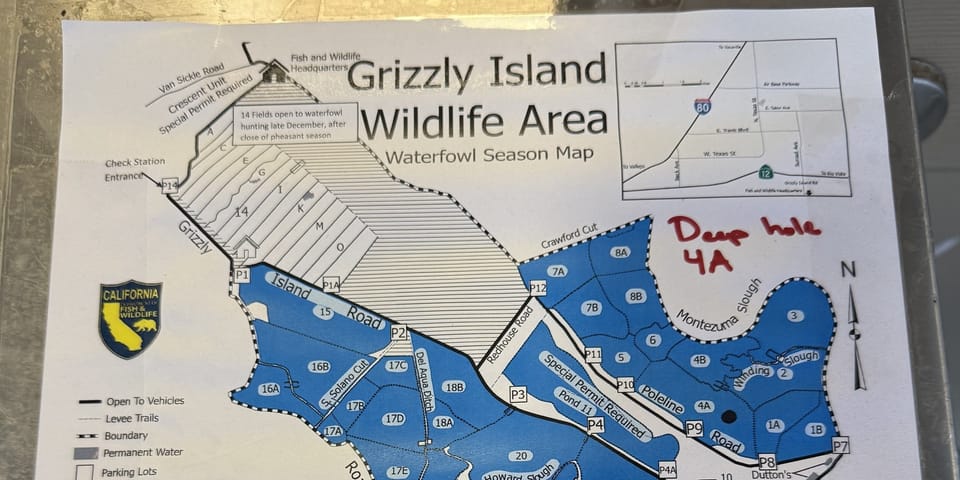
Most wild pheasants shot on California public land come off a dozen or so state wildlife areas and national wildlife refuges in the Sacramento and San Joaquin valleys. They're shared with duck hunters, they run on duck-season shoot days, and one of them produces far more birds than the rest. This guide covers which areas allow pheasants, which rules to check, how to get in on the opener, and what CDFW's harvest counts say about where to go.
Check the current regulations first
Season dates, bag and possession limits, shooting hours and pass prices change from year to year, so we don't list them here. Look them up in CDFW's current upland game bird regulations before you go. You'll need a California hunting license with an Upland Game Bird Validation (junior license holders are exempt), nonlead shot for any firearm hunting, and a pass for Type A and Type B areas.
Two rules catch duck hunters every year. Pheasant shooting starts later in the morning (8:00 a.m. in recent seasons), not at the half hour before sunrise that duck hunters on the same marsh are working with. And the opening weekend has a smaller daily bag than the rest of the season.
Where you can hunt pheasants on public land
California's wildlife areas come in three types. Type A areas limit how many hunters get in each shoot day during waterfowl season, and you need a pass bought in advance to get an entry permit at the check station. Type B areas also need a pass. Type C areas are open daily with no pass.
On Type A and Type B areas, pheasant is a legal species during the pheasant season, but only on waterfowl shoot days: Saturdays, Sundays and Wednesdays. That's the rule at most of the Central Valley areas below. A few have their own twists.
CDFW counts the pheasant harvest at 16 of these areas, and those counts are the best public measure of where the wild birds are. The table ranks them by their average season from 2017 to 2021, the last five seasons in CDFW's summary. The per-hunter column divides pheasants by every hunter visit the check stations logged in November and December, nearly all of them duck hunters, so treat it as a way to compare areas, not as a pheasant hunter's success rate.
| Area | Pheasants per season, 2017–21 average | Pheasants per 100 hunter visits | When pheasants are legal |
|---|---|---|---|
| Yolo Bypass WA | 258 | 6.1 | Shoot days; not in assigned blinds |
| China Island Unit, North Grasslands WA | 49 | 12.4 | Shoot days |
| Gray Lodge WA | 39 | 0.8 | Shoot days |
| Los Banos WA | 29 | 1.4 | Shoot days |
| Little Dry Creek Unit, Upper Butte Basin WA | 27 | 1.3 | Shoot days, plus a drawn hunt |
| Llano Seco Unit, Upper Butte Basin WA | 26 | 3.4 | Shoot days |
| Salt Slough Unit, North Grasslands WA | 25 | 3.3 | Shoot days |
| Delevan NWR | 23 | 0.6 | Shoot days and the refuge Monday hunt |
| Colusa NWR | 20 | 1.0 | Shoot days and the refuge Monday hunt |
| Howard Slough Unit, Upper Butte Basin WA | 18 | 1.3 | Shoot days |
| San Luis NWR | 16 | 1.1 | Shoot days, free-roam area |
| Sacramento NWR | 15 | 0.4 | Shoot days and the refuge Monday hunt |
| Mendota WA | 11 | 0.3 | Shoot days |
| Sutter NWR | 6 | 0.5 | Shoot days; not in assigned ponds |
| Gadwall Unit, North Grasslands WA | 5 | 1.1 | Shoot days |
| Volta WA | 2 | 0.2 | Shoot days |
Shoot days are Saturdays, Sundays and Wednesdays. At Delevan, Colusa and Sacramento refuges, pheasant hunters stay out of the assigned ponds and blinds except on the refuge Monday hunt (below). Sutter keeps pheasant hunters out of its assigned ponds all season, and San Luis has an extra pheasant zone at Kesterson (below).
Yolo is in a class of its own. It produced more pheasants than the next nine areas combined. CDFW's account of its 2024–25 record says the area is about half of California's public-land wild pheasant take. It credits back-to-back wet years that flooded out predators and produced three hatches instead of two, along with habitat work: field edges and ditches left in cover, and water added to upland fields to grow the plants that carry the insects chicks eat.
China Island is the other standout. It's small, but it had the best birds-per-visit figure of any area, about twice Yolo's. The Sacramento Valley refuges that once carried California pheasant hunting, Gray Lodge, Colusa, Delevan and Sacramento, now give up a few dozen birds a season or fewer. Our analysis of the 16-area series shows how far they fell.
A few areas outside this series also allow pheasants, with their own days:
- Grizzly Island WA (Suisun Marsh): a Type A area; pheasants are legal on shoot days.
- Kern NWR: Saturdays and Wednesdays during pheasant season, in the free-roam unit only.
- Butte Valley and Shasta Valley wildlife areas: Sundays only.
- Imperial WA, Wister Unit: Mondays and Thursdays.
- San Jacinto WA, Davis Road Unit: Mondays only.
- Type C areas: Lower Sherman Island, Napa-Sonoma Marshes, O'Neill Forebay, West Hilmar, Eel River, Perris Reservoir and the Sacramento River NWR list pheasant among their legal species, and Type C areas need no pass.
CDFW doesn't publish pheasant counts for these, so we can't rank them.
Getting in: passes, reservations and the opener
Passes. Buy a Type A pass before you go. You trade it for an entry permit at the check station. Junior license holders don't need one.
Reservations. Type A reservations cover waterfowl and pheasant hunting on every authorized shoot day. They're drawn at random through CDFW's license system, online or at a license agent, for $1.34 per hunt choice. Applications have to be in at least 17 days before the hunt date, so apply for the opener in late October. A reservation guarantees entry, and the holder has to be there when the number is called. Type B areas may require reservations for the pheasant opener.
You don't need a reservation to hunt. Once reservation holders are processed, the check stations fill the remaining spots through a lottery or a first-come line, depending on the area. Our guide to getting on a California wildlife area covers how reservations, lotteries and the line work. Over the whole 2025–26 season, reservation odds ran from about 1 in 6 at China Island to 1 in 157 at Little Dry Creek, but those draws are driven by duck hunters.
The refuge Monday hunt. Sacramento, Delevan and Colusa national wildlife refuges open for pheasants on the first Monday of the season. That day the assigned ponds, assigned blinds and free-roam areas are all open to pheasant hunters. USFWS runs a lottery at the check stations the day before, then a first-come list, and there's no overnight stay that Sunday night. Check each refuge's hunt page for this year's times.
San Luis NWR. Pheasants are legal in the San Luis Unit's free-roam area on shoot days for the whole season. There's also a special pheasant zone reached through the Kesterson check station. CDFW's booklet opens it on the first Saturday and Sunday of the season with an entry permit, while the refuge's own page lists a 10-hunter pheasant-only zone open Wednesdays, Saturdays and Sundays all season. Call the refuge before you plan around it. On the first Monday, the Kesterson spaced-blind area opens for a first-come pheasant hunt.
The wild-pheasant draw at Little Dry Creek. CDFW holds one drawn wild-pheasant hunt each fall at the Little Dry Creek Unit of Upper Butte Basin Wildlife Area, through its special hunt application. Each permit holder can bring one hunting guest and one non-hunting guest. It's a long shot: 1,556 hunters applied for 30 spots in 2023 and 1,381 in 2024, and CDFW cut the hunt to 15 permits in 2026.
| Wild-pheasant hunt, Little Dry Creek | Permits | Applicants | Odds |
|---|---|---|---|
| 2023 | 30 | 1,556 | 1 in 52 |
| 2024 | 30 | 1,381 | 1 in 46 |
Released-bird hunts. CDFW also runs drawn hunts on pen-raised pheasants released at wildlife areas and other sites, split into junior, family, new-hunter and veteran hunts. They're not wild-bird hunts, and they don't show up in the harvest counts above, but they're the easiest way to get a new hunter on birds. They run in periods through the season, each with its own application deadline, so check CDFW's special hunt pages early.
In 2025 the junior hunts were often wide open. Mendota's junior-only morning hunt had 25 permits and no applicants. Shasta Valley's two junior-only hunts drew none for 50 permits, and Ash Creek's junior morning hunts drew 12 applicants for 50 permits between them. The family hunts were the opposite: 165 hunters listed the 8-permit family hunt at Sacramento Bypass Wildlife Area among their choices, and 166 listed the 15-permit hunt at Nelson Slough.
Opening weekend or later?
We can't answer this one from the harvest data. CDFW's summary counts pheasants per area per season, not per day, so it doesn't split the opener from the rest of the season.
The check-station counts we have don't settle it either. They're dominated by duck hunters, and on the pheasant opener the 16 areas didn't reliably draw more hunters than the Saturday after: the opener was busier in 6 of the 11 seasons we could compare from 2006 to 2020.
What the rules and the record do show:
- The opener is the short-limit weekend. The daily bag is smaller on opening weekend than the rest of the season.
- There are extra days early. The refuge Monday hunt, on the first Monday of the season, opens the assigned ponds and blinds at Sacramento, Delevan and Colusa to pheasant hunters, the one day all season they're open to them.
- The birds don't run out after the first weekend. In Yolo's record year, the harvest passed the area manager's forecast of 350 to 375 birds by the third week of the season and finished at 687.
- Wednesdays are shoot days too. Pheasants are legal on every Wednesday shoot day of the season at the Type A areas above.
For how opening weekend compares with the rest of the season for ducks, where we do have day-by-day data, see opening weekend vs. mid-season.
Hunting public-land pheasants with a lab
A Labrador is a flushing dog: it quarters in front of you, pushes the bird into the air and brings it back. California's rules allow it. Dogs may be used to take and retrieve upland game. On CDFW lands, a dog working in the field can be off leash. It must be leashed in parking lots and at check stations, and kept within ten feet of you while you walk between the lot and where you hunt.
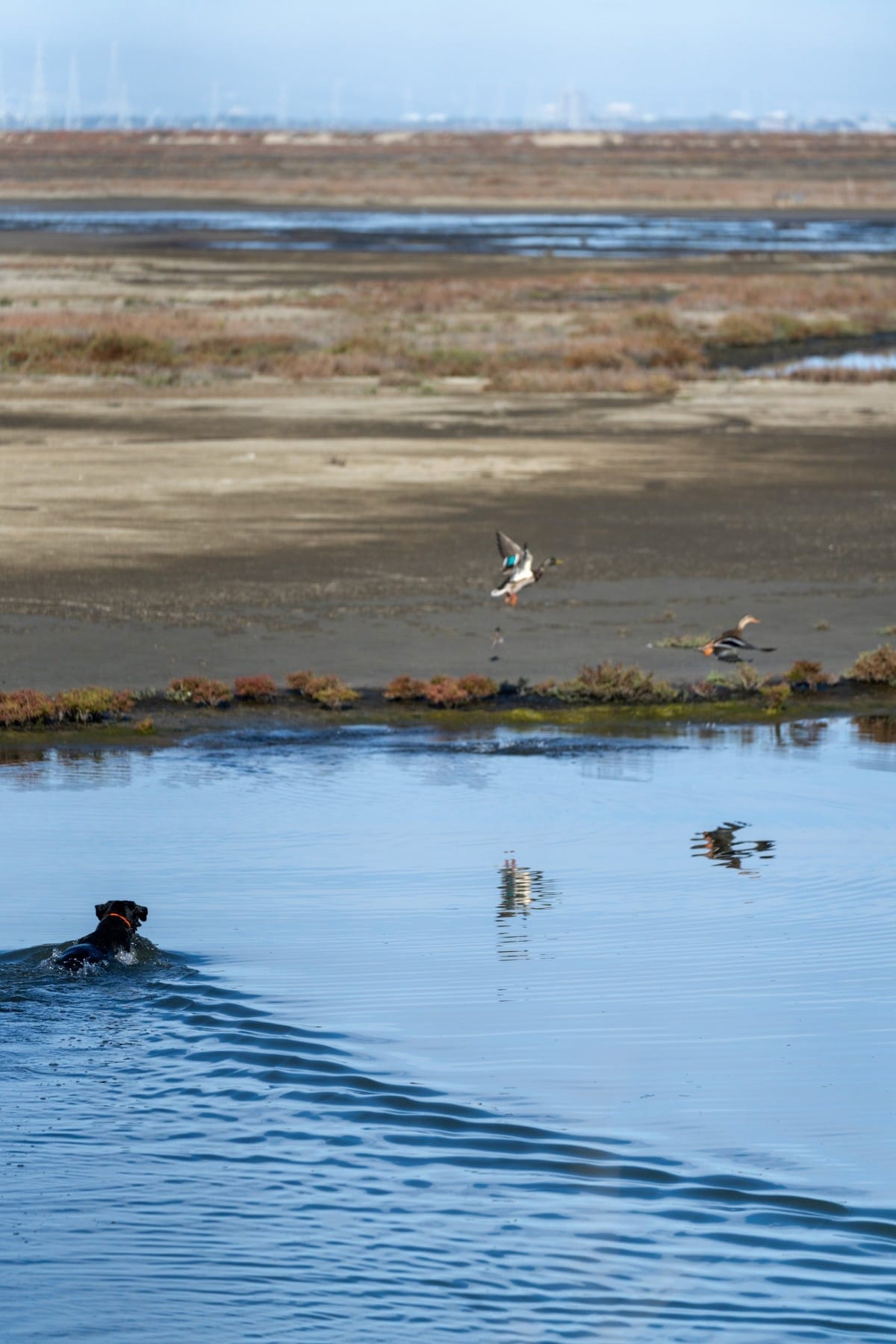
A few things matter more on these areas than on a private field:
- Keep the dog in gun range. A rooster that flushes 50 yards out is gone. With a flusher, the range is set by how far the dog works from you, so call it back before it gets out past where you can shoot.
- Hunt the edges. On the valley wildlife areas the upland cover is often in strips: ditch banks, field edges, levee sides. At Yolo, CDFW leaves field edges and ditches in cover on purpose as travel lanes for birds. Work those edges and the ends of strips, where running birds run out of room.
- Expect runners. Roosters often run ahead of a dog rather than fly. Let the dog follow the scent and keep up with it. When a bird is down, send the dog right away. A wing-hit rooster that reaches heavy cover is hard to find.
- Stay out of the waterfowl spreads. You're sharing the area with duck hunters on the same day. Pheasant hunting isn't allowed in the assigned blind and pond areas at most of these places, and a dog that runs into someone's decoys won't make you friends.
- Watch the clock. Ducks start a half hour before sunrise. Pheasant shooting starts later. Use the early part of the morning to let the dog settle, not to shoot.
Takeaways
- Start at Yolo Bypass. It produced 45% of the pheasants counted on the 16 Central Valley areas in 2017–21 and set a record of 687 wild roosters in 2024–25. Our Yolo Bypass guide covers its duck hunting, draw odds and floods.
- Try China Island for birds per trip. It's small, but it had the best birds-per-visit figure of any area.
- Know the day rules. Most of these areas allow pheasants only on Saturday, Sunday and Wednesday shoot days, and pheasant shooting starts later than duck shooting.
- Apply early for the opener. Reservations close 17 days before each hunt date. Without one, you'll be in the lottery or the sweat line.
- Don't skip the refuge Monday. On the first Monday of the season, Sacramento, Delevan and Colusa refuges open their assigned ponds and blinds to pheasant hunters, the one day all season they do.
- If you have a junior hunter, apply for the released-bird hunts. In 2025 several junior hunts had more permits than applicants.
Sources: CDFW 2026–2027 Waterfowl, Upland Game, and Public Use of Department Lands Regulations (updated July 1, 2026), Sections 300, 310.5, 311, 550, 550.5, 551 and 552. CDFW Ring-necked Pheasant Harvest Summary, 1996–2021 (16 wildlife areas and refuges); 2017–21 averages are five-season means. Pheasants per 100 hunter visits divides each area's 2017–21 pheasant harvest by its November–December check-station hunter visits from CDFW waterfowl hunt reports. Those visitors are mostly waterfowl hunters, so the figure compares areas rather than measuring pheasant hunter success. Yolo Bypass 2024–25 harvest from CDFW's April 8, 2025 Science Spotlight. Special hunt figures are from CDFW drawing statistics (2023 and 2024 wild pheasant hunt; 2025 fall pheasant hunts, Periods 1–3) and CDFW's 2026 special hunt pages. Reservation odds are from CDFW's 2025–26 waterfowl reservation drawing statistics. Refuge Monday hunt and San Luis NWR details are from USFWS refuge hunt pages. Rules change: check the current booklet and each area's page before you go.
See also: California Lost 92% of Its Pheasant Harvest in 25 Years · Pheasant Hunting in California, Oregon and Washington: 75 Years of Harvest Data · How to get on a California wildlife area · Tying Flies With Feathers From the Birds You Shoot