 OutdoorStats
What Is the Pacific Flyway? How North America's Four Flyways Set Your Duck Season
Every waterfowl regulation book in California, Oregon and Washington starts from the same place: the Pacific Flyway. It isn't a lane in the sky. It's one of four regions the federal government uses to manage ducks and geese, and it decides how long your season can run and how many birds you can keep.
Four flyways, drawn for management
Biologists proposed in the mid-1930s that North America's migratory birds move along four broad routes. The federal Bureau of Biological Survey published Frederick C. Lincoln's The Waterfowl Flyways of North America in 1935. From east to west the flyways are the Atlantic, Mississippi, Central and Pacific.
The U.S. Fish and Wildlife Service adopted that structure for managing migratory birds in 1947. In its own words, it did so because of the birds' biology and "the relative number of hunters in these routes." In 1948, federal waterfowl regulations were split by flyway for the first time.
The lines on the map follow state borders, and birds don't. The flyways exist so that states sharing roughly the same birds can set seasons together.
The Pacific Flyway covers Alaska, Arizona, California, Idaho, Nevada, Oregon, Utah and Washington, plus the parts of Colorado, Montana, New Mexico and Wyoming west of the Continental Divide. Those four split states weren't always split. The Service counted Montana as wholly Central Flyway through 1959 and the other three through 1961.
How the flyway sets your season
Each flyway has a council, made up of one member from each state's wildlife agency. Canadian provinces and Mexican states that share the birds sit on it too, but only U.S. states vote on U.S. regulations. The Pacific Flyway Council first met on January 16, 1952, in Pendleton, Oregon.
The process runs in three layers:
- The treaties set the outer limits. Under the migratory bird conventions, hunting can happen only between September 1 and March 10, and for no more than three and a half months. The Service reads that as 107 days.
- The Service sets the maximum for each flyway. For ducks it picks one of four packages (closed, restrictive, moderate or liberal) using a model tied to breeding surveys. In the Pacific Flyway, that model is built on western mallards.
- Each state picks its dates inside the federal maximum. It can be stricter, never looser.
Here is the most each flyway can get, the "liberal" package, next to what its hunters took last season:
| Flyway | Longest duck season | Ducks per day | Active duck hunters, 2024–25 | Ducks taken, 2024–25 | Ducks per hunter |
|---|---|---|---|---|---|
| Atlantic | 60 days | 6 | 252,800 | 2,405,300 | 9.5 |
| Mississippi | 60 days | 6 | 480,200 | 6,404,900 | 13.3 |
| Central | 74 days | 6 | 268,500 | 3,175,200 | 11.8 |
| Pacific | 107 days | 7 | 152,200 | 2,392,100 | 15.7 |
The Pacific Flyway gets the longest season the treaties allow and the biggest daily bag, with by far the fewest hunters. The Service says the differences between flyways "reflect the historic differences in waterfowl abundance and hunter numbers." A Pacific Flyway duck hunter took about 16 ducks over the season, against 9.5 in the Atlantic Flyway.
California uses nearly all of it: its main duck zones usually run from late October to the end of January. Check CDFW's current waterfowl regulations for this season's dates and limits.
The process itself changed this year. In a rule published August 31, 2026, the Service said it will now authorize hunting through a memorandum issued once every three years, instead of a new federal rule every year. It will still review harvest levels annually and update the memo sooner if its decision frameworks call for it.
California is where the flyway's ducks are shot
The Pacific Flyway's harvest has never been spread evenly. Each of the three states we cover has run its own hunter survey for decades, and every one of them shows California far ahead.
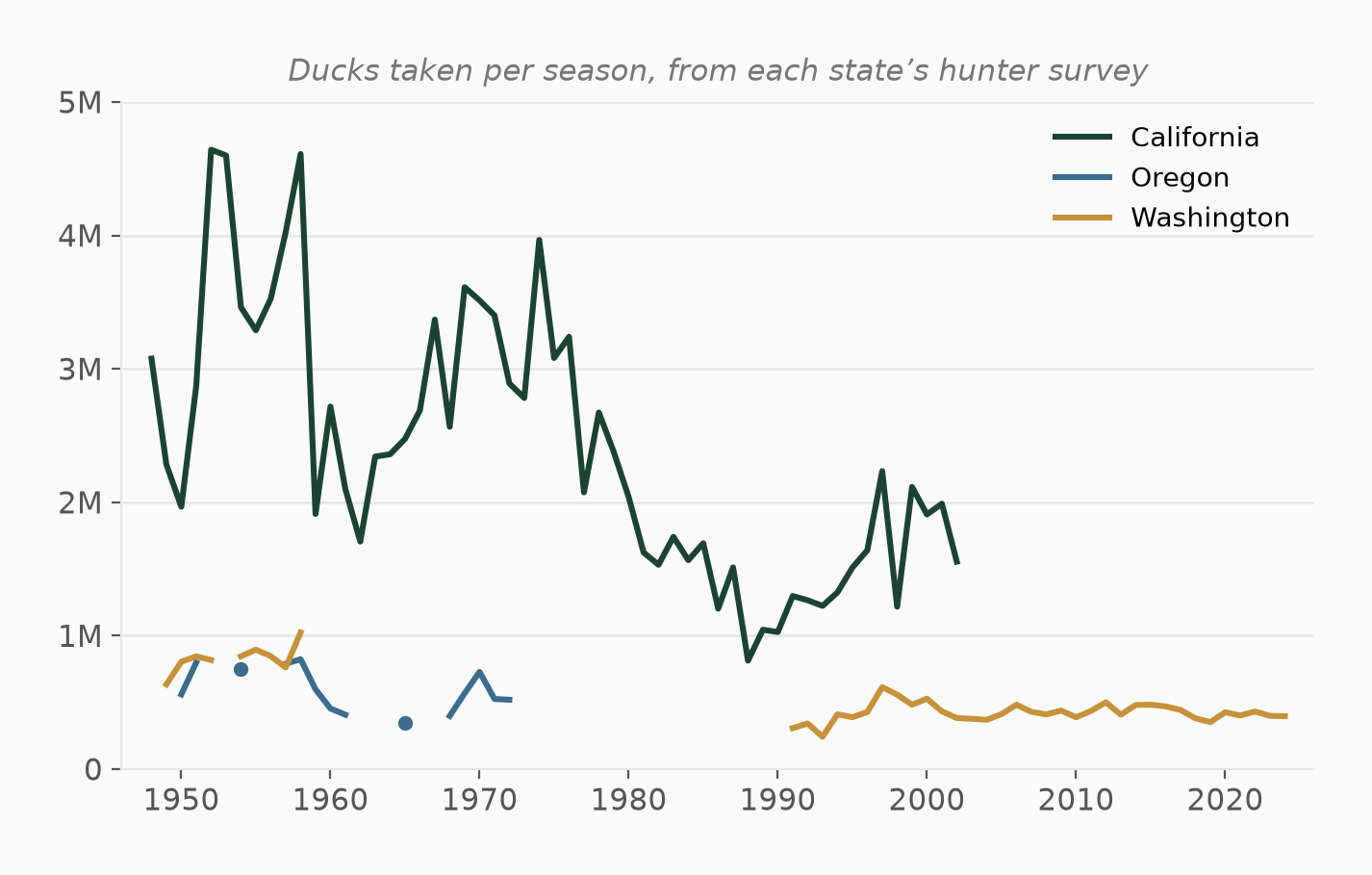
In the five seasons where all three states have a figure (1950, 1951, 1954, 1957 and 1958), California hunters took 68% of the ducks shot in the three states, between 59% and 72% in any one year. California's best season on record was 1952, at 4.64 million ducks. Washington's best was 1.02 million and Oregon's 824,000, both in 1958.
The gap held up as the harvest fell. From 1991 to 2002, the years both states have, California averaged 1.61 million ducks a season and Washington 427,000, almost four to one. Our history of California hunting covers what happened to the hunters: California's duck hunters fell by about 60% between the late 1960s and the late 1990s, while each one took more birds.
We stopped the chart where each state's own survey stops, and we don't splice the federal survey onto it. The federal Harvest Information Program counts differently from the old state mail surveys, so the two can't be joined into one line. On its own count, though, the federal survey tells the same story: in 2024–25, California 1.11 million, Washington 337,000 and Oregon 253,000.
Three places that explain the Pacific Flyway
The Central Valley. USGS says the Central Valley and Suisun Marsh together hold 60% of the Pacific Flyway's wintering waterfowl and 20% of North America's. That goes a long way toward explaining why California's harvest dwarfs its neighbors'. How the share is counted, and how it has changed, deserves its own post.
The Klamath Basin. President Theodore Roosevelt set aside Lower Klamath, on the California–Oregon line, in 1908 as the nation's first waterfowl refuge. USFWS estimates about 80% of the flyway's migrating waterfowl pass through the Klamath Basin in spring and fall, and the refuge alone can hold about 1.8 million birds. Its water comes through the Bureau of Reclamation's Klamath Project canals, which the Service says leaves it "vulnerable to periodic water shortages due to an over-allocated system."
The Aleutian cackling goose. Fur farmers and trappers released foxes on more than 190 islands in this goose's Alaska nesting range, and the birds had no defense against them. The first accurate count, in 1975, found 790 geese. Biologists removed foxes, moved wild families to fox-free islands, and wintering and migration areas in California and Oregon were closed to Canada goose hunting. By 2000 there were an estimated 32,000, and the goose came off the endangered species list in 2001. The Service's 2025 estimate is 205,000.
Where the flyway's ducks spend the summer, and how far north California's birds come from, is a separate story.
- Flyways are management units. The federal government adopted the four-flyway structure in 1947 and first set regulations by flyway in 1948. The boundaries follow state lines, not migration routes.
- California, Oregon and Washington are all Pacific Flyway states. So are Alaska, Arizona, Idaho, Nevada and Utah, and the parts of Colorado, Montana, New Mexico and Wyoming west of the Divide.
- The Pacific Flyway gets the most generous duck rules. In a liberal year that's 107 days and seven ducks a day, against 60 days and six ducks in the Atlantic and Mississippi Flyways.
- Most of the flyway's ducks are shot in California. California took 46% of the Pacific Flyway's ducks in 2024–25 and about two-thirds of the three-state harvest in the 1950s.
- The flyway's anchors are the Central Valley and the Klamath Basin. USGS puts 60% of the flyway's wintering waterfowl in the Central Valley and Suisun Marsh; USFWS says about 80% of its migrants pass through the Klamath Basin.
Source: Flyway history: Pacific Flyway Council (About the Council; J. C. Bartonek, "The Pacific Flyway Study Committee and Council: A History"); F. C. Lincoln, The Waterfowl Flyways of North America, USDA Circular 342 (1935). Regulations: USFWS, "Process for Authorizing Seasonal Migratory Game Bird Hunting," 91 FR 55794 (August 31, 2026), duck season alternatives at 50 CFR 20.117; USFWS general decision frameworks for the Pacific Flyway (August 27, 2026); CDFW 2026–27 waterfowl regulations. Harvest and hunters, 2024–25: USFWS, Migratory Bird Hunting Activity and Harvest during the 2023–24 and 2024–25 Hunting Seasons (preliminary; Pacific Flyway totals exclude Alaska and count all of Colorado, Montana, New Mexico and Wyoming in the Central Flyway). State series: CDFW Game Take Hunter Survey reports, 1948–2002; Oregon State Game Commission Bulletin, 1950–1972; Washington Game Commission and Department of Game reports, 1949–1958, and WDFW Game Harvest Reports, 1991–2024. Places: USGS Western Ecological Research Center (Central Valley); USFWS Lower Klamath and Klamath Basin refuge pages; USFWS Aleutian Canada goose recovery story (2000), delisting rule 66 FR 15643 (March 20, 2001), and Waterfowl Population Status, 2025 (Table 14). All harvest figures are survey estimates. Seasons are labeled by the year they open.
See also: How Do I Go Duck Hunting in California? · 55 Years of California Hunting