 Outdoor Stats
How Do I Go Duck Hunting in California?
If you've never been duck hunting in California and you're trying to figure out how to actually get started, this is for you. No gatekeeping, no assumption that you already know what a Type A wildlife area is. Just the stuff you need to know to get out there.
What you need before anything else
Before you set foot on a wildlife area, you're going to need a stack of licenses and validations. It feels like a lot the first time, but once you've done it once, renewals take about ten minutes online each year.
Here's the full list:
| What | Why | Where to Get It |
|---|---|---|
| California Hunting License | Required for any hunting in the state | CDFW License Sales |
| California Duck Validation | Required for migratory waterfowl | Included during license purchase |
| Federal Duck Stamp | Required nationwide for waterfowl (age 16+) | USPS or included during license purchase |
| HIP Validation | Harvest Information Program — federal requirement | Prompted automatically during license purchase |
| Wildlife Area Hunting Pass | Required for Type A and Type B wildlife areas | Online, CDFW offices, or license agents (Big 5, Walmart, etc.) |
The HIP validation is a short survey about your hunting activity. It's rolled into the license purchase now, so you can't skip it even if you tried.
The hunting pass is what gets you through the gate at Type A wildlife areas. You can buy a one-day pass, a two-day pass, or a season pass. You cannot buy passes at the check station — they need to be purchased in advance online at ca.wildlifelicense.com, at a CDFW license office, or at a license agent like Big 5 or Walmart. If you order online, allow 15 days for delivery.
The optional validation that's worth buying
There's one more: the California Upland Game Bird Validation. It's $16.25 and it covers pheasant, turkey, quail, and rabbit.
You don't technically need it for ducks. But if you're on a wildlife area during pheasant season and you kick one up out of the tules — and you will eventually — you're going to wish you had it. It's cheap insurance. Buy it every year.
Hunter education
If you've never held a hunting license in California (or anywhere else), you'll need to complete a Hunter Education Course before you can buy your license. It's a one-time, lifetime requirement.
The course covers firearm safety, wildlife identification, ethics, regulations, and field skills. CDFW offers three formats:
Traditional (In-Person) Minimum 10 hours of classroom, homework, and field instruction. Best for people who want hands-on learning. Register at register-ed.com/programs/california.
Hybrid (Online + Follow-Up) Complete the online course through hunter-ed.com/california, then attend a required 4-hour in-person follow-up with a certified instructor. Register for the follow-up at register-ed.com/programs/california.
Online Only Take the full course online through hunter-ed.com/california. This is the easiest path — do it on the couch over a weekend and you're done.
Before registering, you'll need a CDFW GO ID. If you've previously bought a fishing license, your GO ID is printed on it. If not, create one at ca.wildlifelicense.com or call (800) 565-1458. Once you pass the course, your certificate is automatically added to your CDFW customer profile within 48 hours.
Where do you actually go?
If you didn't know any better, duck hunting in California would seem like serial killer behavior. You're driving down a country road, off a country road, off another country road, at 3 AM in winter. It's dark. It's raining. You're hoping for wind. You're in the middle of the Sacramento Valley and there's nothing around for miles.
That's normal. That's the gig.
California runs a network of public wildlife areas managed by CDFW and the U.S. Fish and Wildlife Service. There are roughly 40 of them spread across the Central Valley, from the Klamath Basin down to Kern County.
Three types of wildlife areas
Not all wildlife areas work the same way. CDFW classifies them into three types:
Type A — the most common type for waterfowl hunting. These are the big-name areas: Gray Lodge, Grizzly Island, Yolo Bypass, Upper Butte Basin, Los Banos. They have managed wetlands, check stations, and a full reservation system. Reservations are available for all authorized shoot days of the season. You'll need a hunting pass (one-day, two-day, or season) every time you check in.
Type B — found primarily in the Northeastern Zone. Reservations are required for opening weekend and possibly the pheasant opener, but access is less restricted the rest of the season. You'll need a season pass — day passes are not accepted at Type B areas.
Type C — specialized areas where restricted access may be required. Entry permits, passes, or special drawings may apply depending on the specific area and time of year.
Most of this guide — and most of what matters for new hunters — is about Type A.
The check station: how it works
Every Type A wildlife area has a hunter check station. This is the single point of entry and exit. Here's the flow:
Step 1 — Arrive and wait your turn
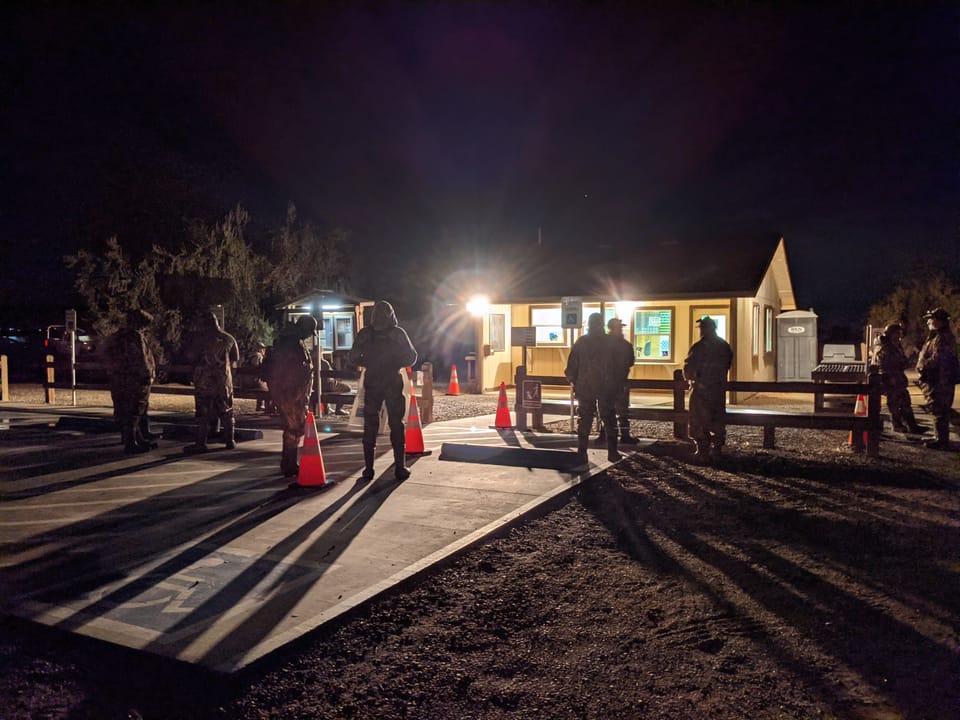
You pull up to the check station in the dark. The rangers are processing hunters in order — reservation holders first, by number, then lottery, then sweat line. When it's your turn and they're ready to let you on, they'll check your hunting license, validations, and photo ID. Then they take your day pass (or scan your season pass) and hand you a daily harvest card.
The harvest card is a small paper card where you'll record what you shoot that day. This is different from HIP — the harvest card is specific to this wildlife area, this day.
Step 2 — The hunt
Once you're checked in, you drive onto the wildlife area. Depending on the area, you might park at a designated lot and walk to a pond, or you might drive to a specific zone or blind. You find your spot, set up your decoys, and wait for legal shooting time.
Legal shooting time is generally 30 minutes before sunrise. You'll hear the first shots in the dark. Season dates, bag limits, and shooting hours are published annually in the California Waterfowl Regulations.
Step 3 — Check out
When you're done — whether that's 8 AM or 2 PM — you pack up, drive back to the check station, and hand in your harvest card. The ranger records how many birds you shot, broken down by species. Mallards, pintail, teal, wigeon — they want to know what you got.
You need to stay within the daily bag limit. For ducks, it's typically 7 per day with species-specific sub-limits (e.g., 2 pintail, 1 canvasback). The exact limits change by season, so always check the current regs.
Once they record your card, you're done. Head home, clean your birds, and start thinking about the next hunt.
What to expect your first time
It's early. Not "early morning" early. It's "alarm goes off at 1:30 AM and you're driving by 2" early. Reservation holders need to be at the check station roughly 2 to 2.5 hours before shooting time — that's when they start processing reservations in numerical order. If your reservation expires, you lose your priority. The lottery typically runs about an hour after reservations start.
It's dark and cold. You'll be standing in mud in the dark. Dress for it. Waders, layers, gloves, a headlamp. November nights in the valley get into the 30s.
It's social in a weird way. The check station parking lot at 4 AM has a tailgate vibe. People making coffee, dogs in truck beds, hunters trading reports on which ponds had birds yesterday. It's a community.
You might not shoot anything. Especially early on. Duck hunting has a learning curve — reading the birds, setting decoys, calling, picking your shots. Some days the birds don't cooperate regardless of experience. That's part of it.
It's addicting. Fair warning.
What about gear?
We're keeping this post focused on the process — how to actually get out there. Gear is a topic that deserves its own deep dive (shotgun, shells, waders, decoys, calls, blind bags, dog or no dog). That's coming.
For now: you need a shotgun (12 gauge is standard), non-toxic shells (steel shot is most common), waders, warm layers, and decoys. Everything else is optimization.
Bottom line
Getting into duck hunting in California isn't complicated, but it is a process. Licenses, validations, passes, check stations, regulations — there's a stack of things to sort out before your first hunt. The good news is it's a one-time learning curve. After your first season, it's all muscle memory.
The harder question isn't what you need. It's how you actually get a spot on the wildlife area. That's where reservations, the lottery, and the sweat line come in — and that's a whole separate system worth understanding.
This is a general guide based on California's public wildlife areas as of the 2025–26 season. Regulations, fees, and procedures change annually — always verify current rules at wildlife.ca.gov before heading out.