 Outdoor Stats
The Full Moon Myth: What 25,000 Hunt Days Say About Moon Phase and Duck Hunting
Every duck hunter has an opinion about the full moon. Most of them think it kills the hunt — birds feed all night, sleep all day, and your decoys sit untouched. Twenty-two seasons of data say that's wrong. But the truth is more interesting than the myth.
Moon phase doesn't predict harvest — at all
We compared moon illumination against harvest residuals — the part of daily harvest that isn't explained by which refuge, which week, which season, or which day of the week. The correlation is effectively zero — no pattern at all.
Broken into eight lunar phases, there's no consistent pattern. Full moons, new moons, quarters — they all cluster around zero. No phase reliably produces better or worse hunting.
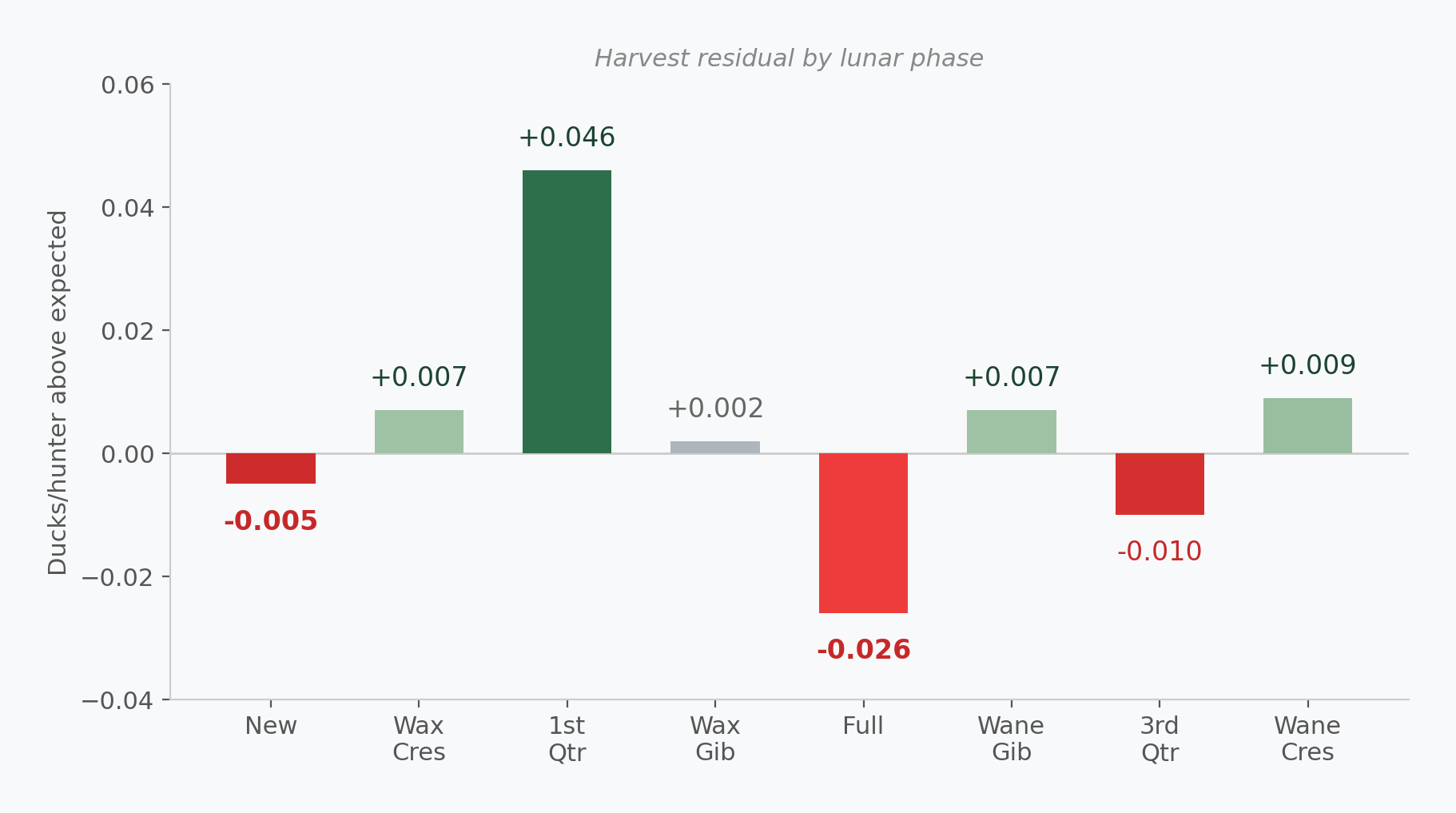
And it's not that we didn't have enough data to find an effect. With 25,000 hunt-days, even a tiny consistent pattern would show up clearly. If the full moon cost you even a fraction of a bird, we'd see it. We don't.
But clear-sky full moons are different
Here's where it gets interesting. When we separate full moon nights by sky conditions using ERA5 satellite cloud data, a signal emerges.
Full moon with clear sky (overnight cloud cover below 25%) produces slightly better hunting the next morning: +0.09 ducks per hunter above dark-night baselines. This effect survives Bonferroni correction — it's the strongest signal in our entire analysis.
Full moons with cloudy skies? Right at the baseline. No different from any other phase.
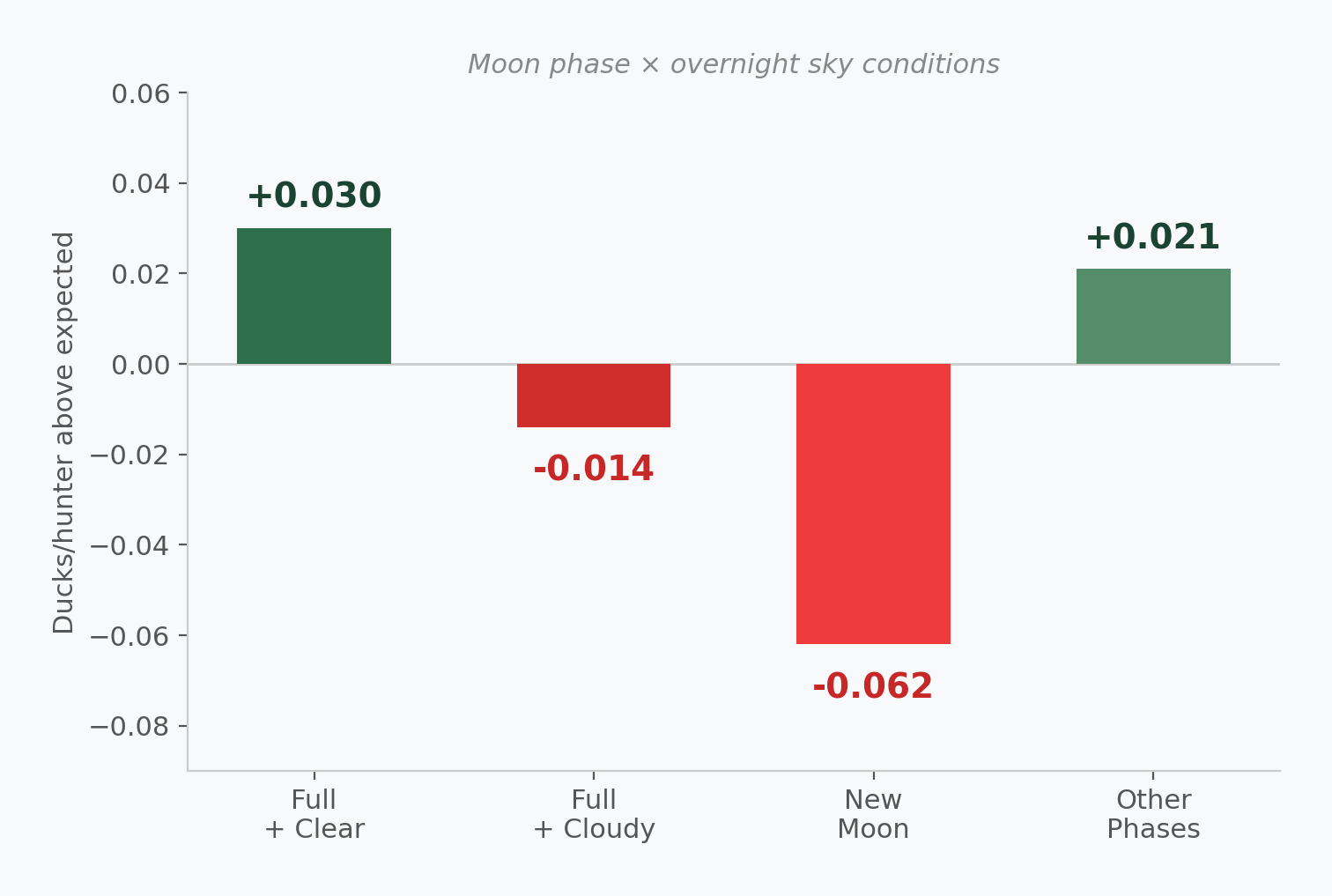
The direction is the opposite of what most hunters believe. Bright nights don't hurt — they help slightly. The effect is tiny — about 11 trips per extra duck — but it's a real pattern, not a fluke.
The rice belt theory
Why would bright nights help? One plausible mechanism: on bright, clear nights, ducks fly from refuges to rice fields to feed. They spend the night in the rice, then return to the refuge at dawn — right when hunters are set up.
If this theory holds, the bright-night effect should be strongest in rice-growing regions (Sacramento Valley, San Joaquin Valley) and weaker elsewhere.
That's roughly what the data shows.
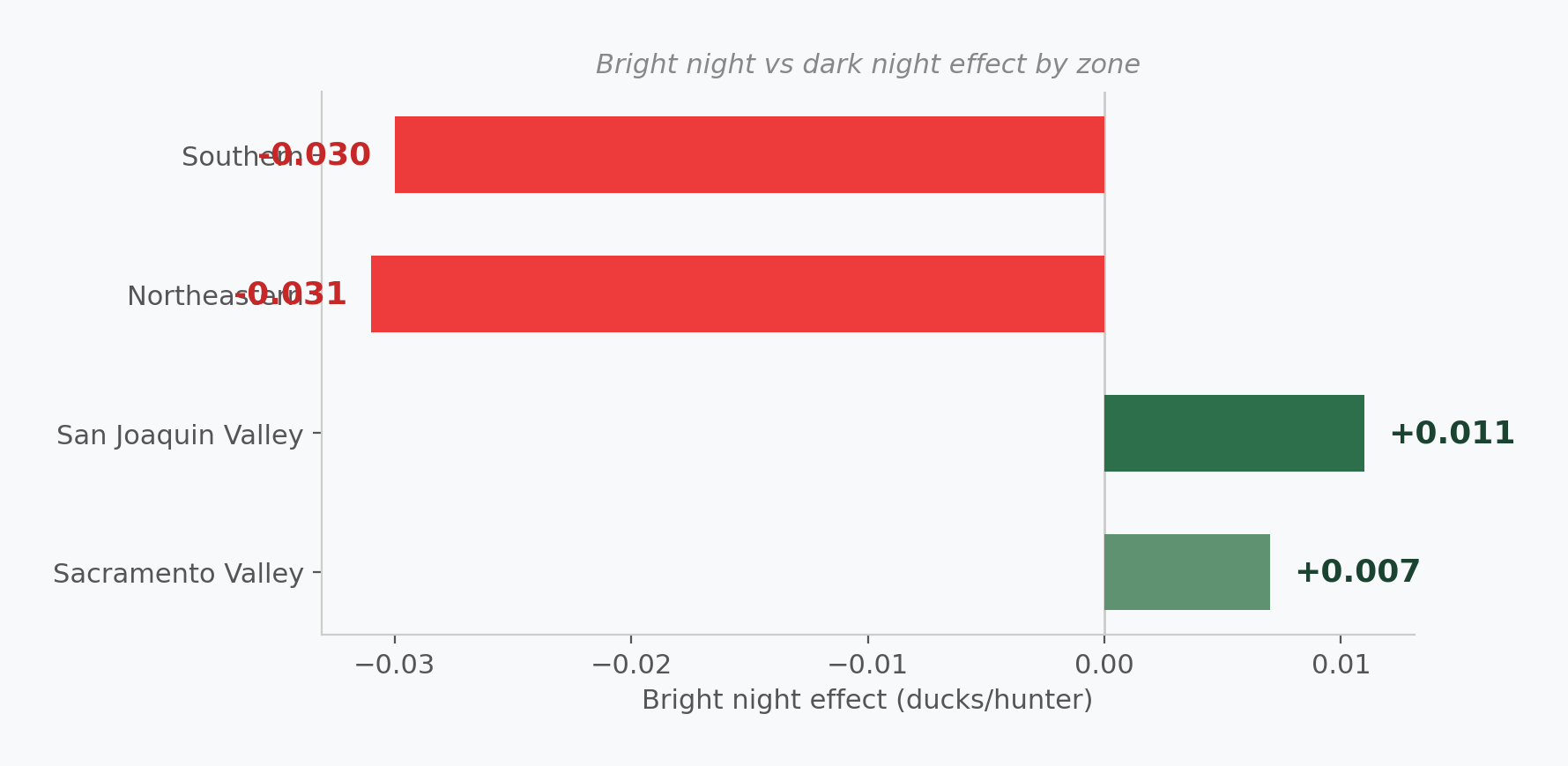
This is suggestive, not conclusive. It's a post-hoc exploration — we looked for this pattern after seeing the bright-night signal, which weakens the statistical claim. More work is needed to test the feeding-flight hypothesis directly.
How many trips to earn one more duck?
| Variable | Effect per trip | Trips for +1 duck | Statistically real? |
|---|---|---|---|
| Bright night (vs dark) | +0.09 | 11 | Yes — not a fluke |
| Moon illumination | ~0 | 476+ | No — likely noise |
Even the strongest moon-related effect — clear-sky full moons — takes 11 trips to deliver one extra bird. Moon illumination as a continuous variable does nothing at all.
Why everyone "knows" the full moon is bad
The myth persists because it feels true. A slow morning after a bright night is memorable. A good morning after a bright night is attributed to something else — wind, cold front, lucky spot. And nobody's tracking their own data rigorously enough to separate signal from noise.
With 25,000 data points, we can. And the answer is: moon phase alone doesn't predict your hunt. If the moon matters at all, it matters when combined with clear skies — and even then, it's a slight positive, not the negative hunters expect.
- The full moon myth is busted. Moon illumination has zero correlation with harvest across 25,000 hunt-days. Full moons don't cost you ducks.
- Clear-sky full moons show a small positive effect. +0.09 ducks per hunter compared to dark nights. The direction is opposite to what most hunters believe.
- The rice belt theory is plausible but unproven. Bright nights may push birds to feed in rice fields overnight, improving morning return flights to refuges. The zone data is suggestive but this is post-hoc exploration.
- Don't plan your hunts around the moon. At most, the moon adds one bird per 11 trips. The far bigger factors are which refuge you hunt, what week of the season it is, and simply showing up.
Source: 25,040 hunt-days across 37 CDFW wildlife areas, 2003–2026. Moon phase via PyEphem. Overnight cloud cover from Open-Meteo ERA5 hourly reanalysis (6 PM–7 AM). Five tests with Bonferroni correction. How we control for seasonality, location, and pressure.
See also: Does Weather Actually Affect Duck Hunting? · Interactive map of all 37 areas