 Outdoor Stats
Does Weather Actually Affect Duck Hunting?
Hunters spend hours debating whether rain, wind, or cold fronts move ducks. We ran 25,000 days of check-station data through a controlled analysis. The effects are real — and far smaller than you think.
The hard part: separating weather from everything else
A naive look at the data would show that rainy days have better hunting. But rainy days happen more in December and January — when harvest is already better because of migrant birds. Geography matters too: some refuges are rainier AND more productive.
To isolate weather's actual effect, we compare within the same refuge, same week, same season. Gray Lodge, week 8, 2019 had three hunt days with different weather but the same birds, same pressure, same point in the season. We also adjust for day of week — Sundays average 0.4 fewer ducks per hunter than Saturdays because of accumulated pressure.
What's left after stripping out timing, geography, and day-of-week patterns is the weather signal.
| Day | Avg Ducks/Hunter | vs Saturday |
|---|---|---|
| Wednesday | 1.91 | -0.05 |
| Saturday | 1.96 | — |
| Sunday | 1.57 | -0.39 |
Rain: real, but barely
Heavy rain days produce +0.06 more ducks per hunter than dry days, after controlling for everything else. That's a real pattern, not a fluke — but it's small.
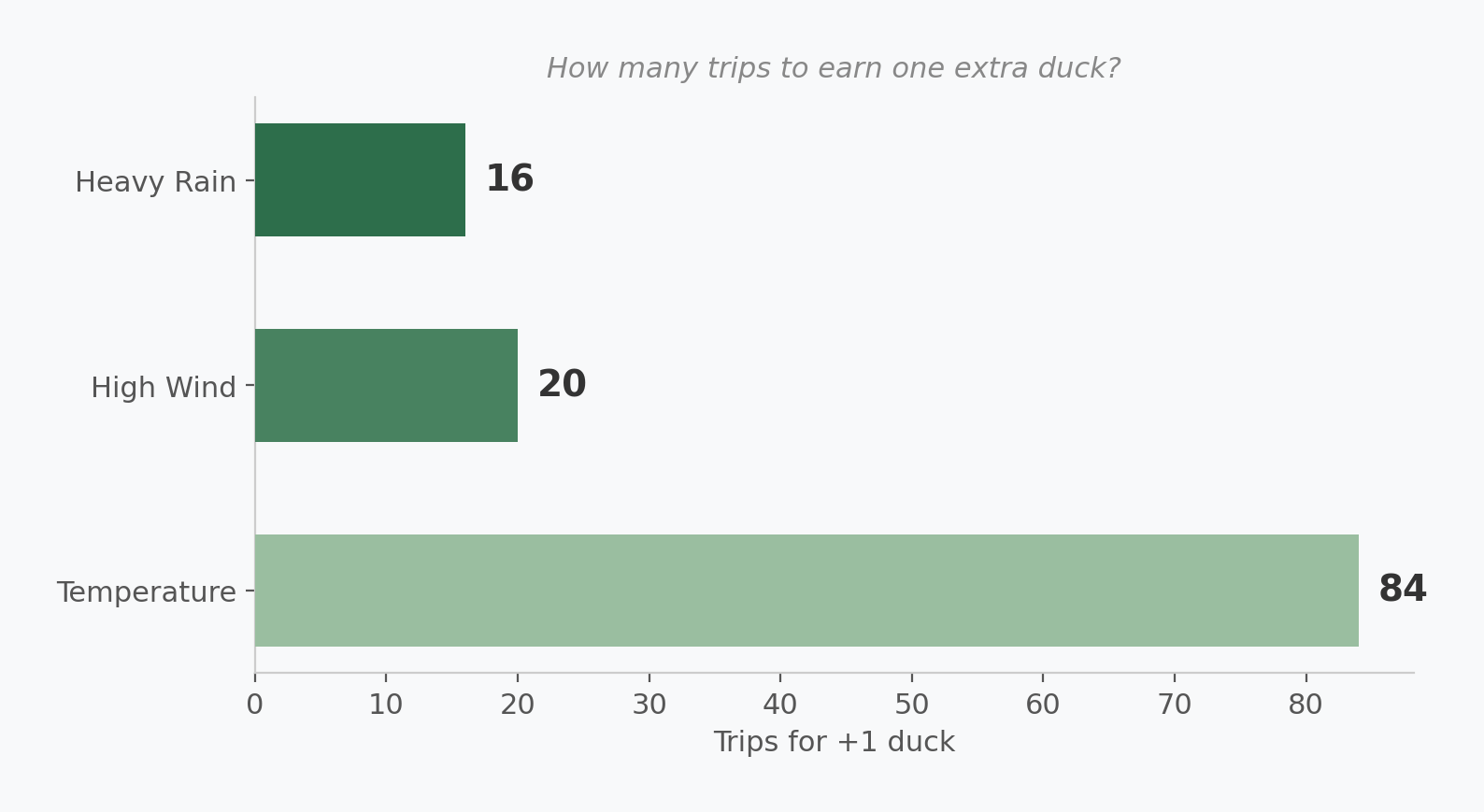
How small? At +0.06 ducks per trip, you'd need to hunt 16 rainy days instead of dry days to accumulate one extra bird. Over a 3-month season with maybe 20 hunt days total, that's not a difference you'd ever notice.
Wind: also real, also tiny
Windier days produce +0.05 more ducks per hunter. The top third of wind days (roughly 15+ mph) outperform calm days. This also survives statistical correction.
The mechanism makes sense — wind keeps birds moving, breaks up rafted flocks on big water, and pushes birds into shooting range. But the effect is 20 trips per extra duck. You'd notice it across a lifetime of hunting, not a single season.
Temperature: nothing
Cold days, warm days, average days — it doesn't matter. The correlation between temperature and harvest is r = -0.003 with a p-value of 0.64. There is no signal here at all.
This might surprise hunters who swear by cold fronts. But remember: we're comparing within the same week at the same refuge. A cold snap in week 10 at Grizzly Island is compared to a warm day in week 10 at Grizzly Island — same birds are in the area either way. The cold front didn't bring new birds; it just changed what you wore.
How many trips to earn one more duck?
The smallest meaningful difference is one more bird in the bag. Here's how many trips each weather variable needs to deliver that:
| Variable | Effect per trip | Trips for +1 duck | Statistically real? |
|---|---|---|---|
| Heavy rain (vs dry) | +0.06 | 16 | Yes — not a fluke |
| High wind (vs calm) | +0.05 | 20 | Yes — not a fluke |
| Cold (vs warm) | -0.01 | 84 | No — likely noise |
Why the debate never gets resolved
Hunters argue about weather because they're pattern-matching on noise. At +0.05 ducks per trip, the rain and wind effects are invisible on any individual hunt. A hunter who goes out 20 rainy days might bag 1 extra duck total compared to 20 dry days — spread across all those trips, they'd never notice.
But everyone remembers the incredible hunt in the pouring rain and the slow bluebird day. Confirmation bias does the rest. You're not wrong that rain helps. You're wrong about how much.
- Rain and wind have real effects. They survive the strictest statistical tests. But they're tiny — one extra duck per 16-20 trips.
- Temperature does nothing. Cold fronts don't improve same-week harvest at the same refuge. The birds are already there.
- No weather condition "makes or breaks" a hunt. The difference between the best and worst weather is 0.06 ducks per hunter. That's one-thirtieth of an average bag.
- Go hunt more. The single best way to bag more birds is to show up. A day on the couch is a guaranteed zero-bird day, and no amount of weather can make up for that.
Source: 25,040 hunt-days across 37 CDFW wildlife areas, 2003–2026. Weather from Open-Meteo ERA5 reanalysis. Five tests with Bonferroni correction. How we control for seasonality, location, and pressure.
See also: The Full Moon Myth · Interactive map of all 37 areas