Best Days to Hunt California Waterfowl Refuges
Most California waterfowl refuges run on a three-day schedule: Wednesday, Saturday, and Sunday. Saturday is the default for most hunters. But is it actually the best day?
We pulled every check station record CDFW has published across all 40 public hunting areas — over 26,000 hunt-days going back to 2003 — and the answer might change how you plan your season.
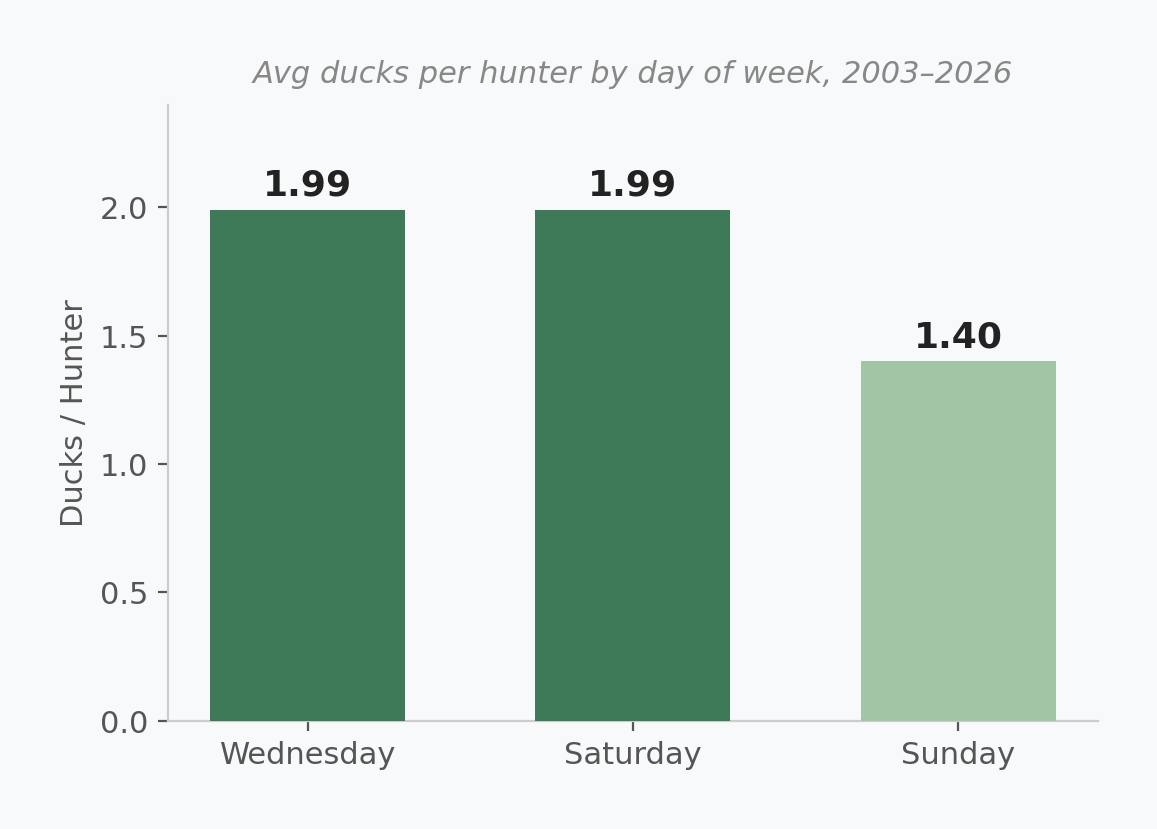
Wednesday matches Saturday — with 42% fewer hunters
Across two decades of data, Wednesday and Saturday produce the exact same harvest rate: 1.99 ducks per hunter.
| Day | Avg Ducks/Hunter | Avg Hunters per Area |
|---|---|---|
| Wednesday | 1.99 | 60 |
| Saturday | 1.99 | 85 |
| Sunday | 1.40 | 54 |
Same harvest, 42% fewer hunters per area. That means less pressure on the birds, shorter check station lines, and quieter blinds.
Sunday is a different story. Hunters average just 1.40 ducks — 30% below Wednesday or Saturday. That gap is consistent across every season in the dataset.
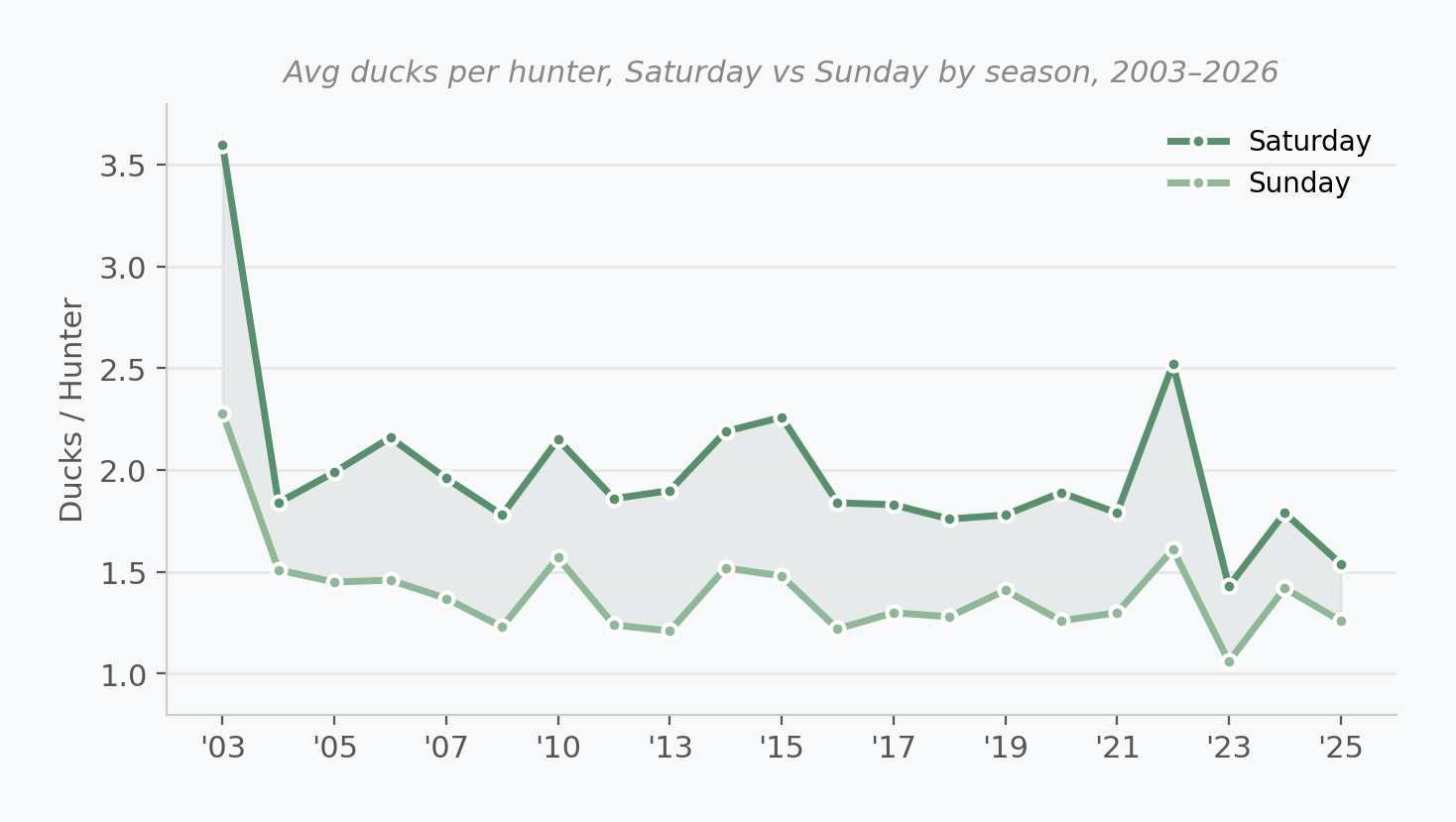
Saturday vs. Sunday: 21 seasons, zero exceptions
We expected to find at least one season where Sunday came out ahead. There isn't one. In 21 seasons, Saturday has beaten Sunday every time.
The likely explanation is cumulative pressure. A full day of hunting on Saturday pushes birds into areas that aren't accessible on Sunday. There's also a selection effect — more experienced hunters tend to choose Saturday when they can only get one weekend day.
Whatever the mix of causes, twenty years of data all point the same direction. If you can only hunt one weekend day, it should be Saturday.
November is a grind — and the numbers prove it
Ask anyone who hunts refuges regularly and they'll tell you November is a grind. The data backs that up — and puts a number on it.
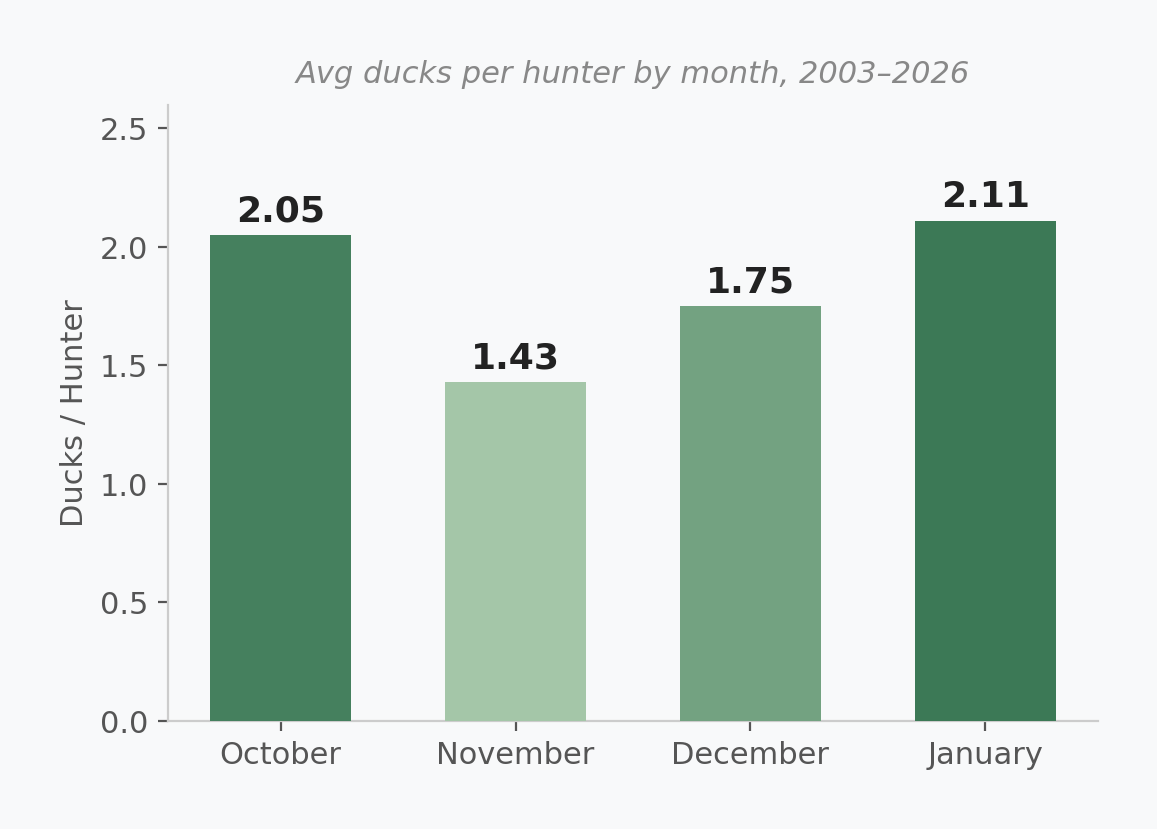
January leads at 2.11 ducks per hunter. October is close behind at 2.05. November sits dead last at 1.43.
October openers hit fresh birds — early teal, local mallards, wigeon that haven't been pressured. By November, those residents are educated but the northern migrants haven't fully arrived. It's a gap between the early birds getting stale and the late birds still being in Oregon.
By January, the valley is loaded. Northern storms keep pushing birds south, and as agricultural fields drain, refuges concentrate what's left. The harvest numbers reflect that.
Late January is the best hunting of the year
January doesn't just lead the season — it gets better as the month goes on.
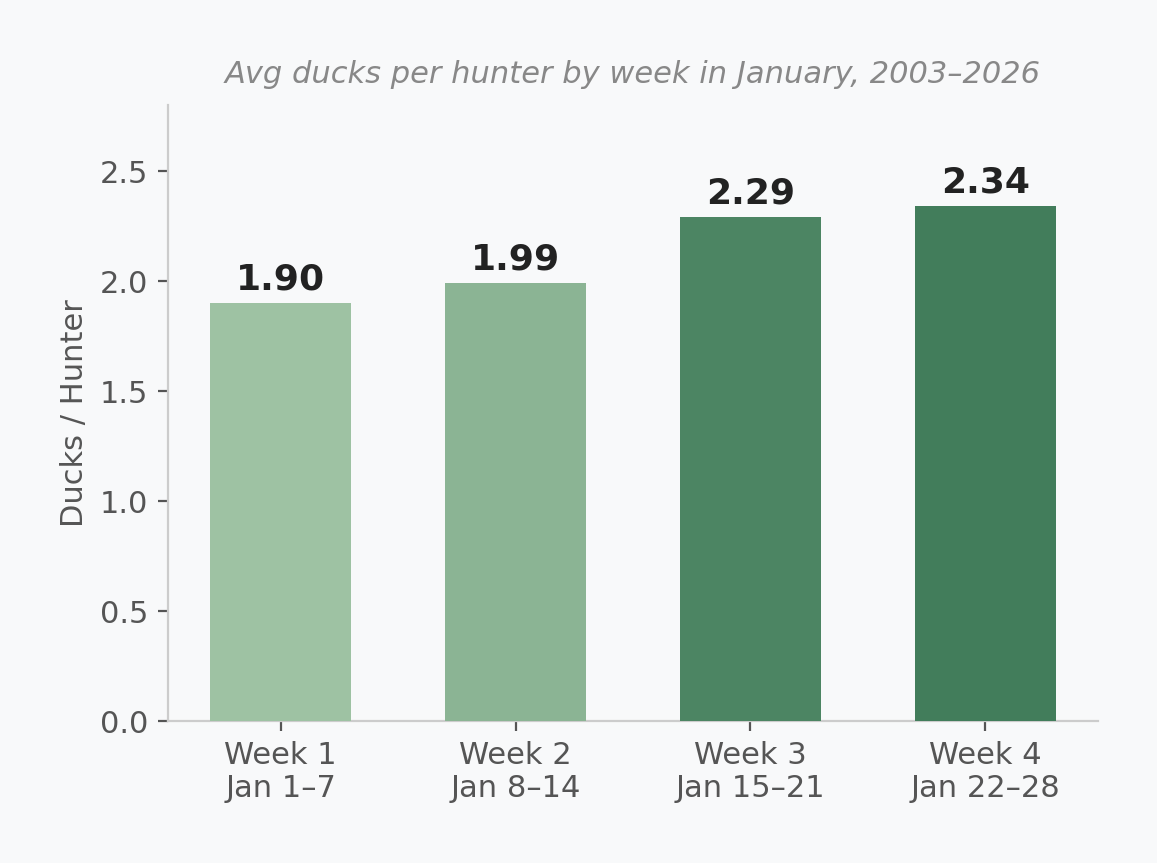
Weeks 3 and 4 average 2.29–2.34 ducks per hunter — about 23% above early January. As fields drain, remaining water concentrates birds on refuge impoundments.
Hunter turnout climbs too (95 per area in week 4 vs. 76 in week 1), but the bird density more than compensates. The last two weeks are consistently the best hunting of the season.
Opening weekend is still king
Where it matters most
The Wednesday advantage varies by area. Here are the top refuge-day combinations with at least 100 hunt-days of data:
| Refuge | Best Day | Avg Ducks/Hunter |
|---|---|---|
| Kern | Wednesday | 3.25 |
| Delevan | Saturday | 3.09 |
| Delevan | Wednesday | 3.08 |
| Little Dry Creek | Wednesday | 2.84 |
| Little Dry Creek | Saturday | 2.83 |
| Gadwall | Saturday | 2.78 |
| Gadwall | Wednesday | 2.64 |
| Colusa | Saturday | 2.62 |
Kern on a Wednesday leads the state at 3.25 ducks per hunter across 220 hunt-days. Delevan and Little Dry Creek both show Wednesday matching or beating Saturday. These are strong midweek options if you can make the schedule work.
Takeaways
- Hunt Wednesdays. Same harvest rate as Saturday, 42% fewer hunters. It's the most efficient day on the schedule.
- Saturday over Sunday. Sunday has underperformed Saturday in all 21 seasons we measured.
- Stay through January. Weeks 3 and 4 produce the best numbers of the entire season.
- Don't miss the opener. 3.51 ducks per hunter — nearly double the season average.
- Expect a slow November. It's the weakest month in the data. December and January make up for it.
Source: 26,145 hunt-days across 40 CDFW public hunting areas, 2003–2026 seasons. Regular hunt days only — youth, veteran, and disability hunts excluded. Harvest measured as ducks per hunter checked at the station.
See all 40 areas on the interactive map.